When the Attacker Is an AI Agent: What Changes for Detection and Response

In August, a developer published a free tool called ARTEX on GitHub. It was built for penetration testers, the people companies hire to break into their own systems and report what they find. A tester could describe a goal in plain language, and AI agents would work out the commands and run them.
Within two months, attackers were using it for the real thing. The original repository has been taken down, but copies, forks and a commercial version are still circulating, and researchers at Censys have counted more than 1,600 ARTEX consoles exposed on the internet. On November 13, the FBI issued a flash alert saying the tool is being used to "automate multiple phases of cyber intrusions at machine speed, from reconnaissance through data exfiltration," as The Record reported. The targets so far include banks, government agencies, energy companies, manufacturers, telecom providers and healthcare organizations.
Security teams have been told for years that attackers would start using AI. ARTEX is what that looks like in practice, and it changes more for defenders than the headlines suggest.
What ARTEX changes
The techniques ARTEX uses are familiar. Scanning for weak points, stealing credentials and moving through a network are what attackers have always done. What has changed is who can do it, how many targets they can work at once, and how quickly it all happens.
Start with skill. A full intrusion used to take a team that knew what it was doing. The FBI's alert says ARTEX "enables threat actors with minimal technical expertise to conduct complex, multi-target operations." Someone who could never have run such an attack by hand can now describe what they want and let the agents do the work.
Scale follows from that. A human crew works on one target at a time, or a handful. Agents do not get tired or lose focus, so one operator can point them at many organizations at once and see which ones give way.
Then there is speed. The FBI says some of the intrusions it reviewed went from first targeting to privileged access in under three hours. In a separate report this month, Microsoft described a case in which an attacker's AI agent went from finding a leaked secret to pulling data out of a cloud vault in five minutes. Those are individual cases and plenty of attacks will be slower. They do show how short the window can get, and a defender has no way of knowing in advance which kind is coming.
Most SOCs were built to catch human attackers
Almost everything about how a SOC runs assumes there is a person on the other side. Alerts can wait in a queue because an intruder used to need days to get anywhere. Analysts work in shifts, and response targets are measured in hours.
All of that made sense against attackers who worked at human pace. An AI agent works in seconds, at any hour, and against many targets at once. So the rest of this piece looks at what has to change, first in detection and then in response.
What has to change in detection
There is one piece of good news in the FBI's alert. It says ARTEX "generates high volumes of forensically noisy traffic that may trigger alerts," according to Healthcare IT News. These attacks are loud. The agents probe widely and try many things, and most security tools will notice at least some of it.
The trouble is that this kind of evidence is easy to miss. Four things need to change.
Stop tuning out the noise
The usual answer to a noisy rule is to turn it down. A team that receives thousands of alerts a day has little choice, so thresholds go up and low-severity alerts get closed in bulk. Against an attacker that announces itself through volume, that habit hides the very activity that matters. Asking analysts to read everything is not realistic. Every alert has to be looked at by something, including the dull ones.
Watch how fast things happen
A person working through a network stops to read the output and think, and minutes pass between steps. An agent takes seconds. It tries small variations when something fails and often runs several lines of attack side by side. Most detections look at what happened and ignore how quickly it happened. A sign-in, a permissions change and a data request are each ordinary. All three from one account within a few seconds is something a person rarely does.
Rely less on known indicators
A lot of detection still depends on recognizing something seen before, such as a file hash, an IP address or a known tool. When an AI agent writes its own commands for each target, much less of that repeats. Detections need to describe behavior, and they need to be revised as the behavior shifts. For a team that reviews its rules a few times a year, that is a big adjustment.
Connect what different tools see
The case Microsoft described moved from a code repository to an identity system to a cloud vault. Each tool along the way saw one slightly odd event. The sequence was the alarming part, and no single tool saw the sequence. Detection has to work across identity, cloud and endpoint data together, because that is how these attacks run.
Why response has to keep the same pace
Catching the activity is only half of the job. In most SOCs, an alert is triaged, assigned, investigated, escalated and discussed before someone decides to disable an account or isolate a machine. Together those handoffs take hours, and sometimes a shift change or a weekend sits in the middle.
The FBI's alert is blunt about what that means against ARTEX: "attack speed provides limited time for coordinated defender response." A process built around handoffs between people cannot finish before an attack that is run by software.
None of this is an argument for letting software act without oversight. Isolating a production server or locking out an executive's account has real consequences, and a person should make that call. What has to go is the waiting that comes before the decision. If the investigation is already done when the analyst opens the alert, with the evidence laid out and a recommended action ready to approve, the analyst's time goes to deciding. The response can then happen in minutes, and a person is still accountable for it.
What does not change
It would be a mistake to treat ARTEX as a new kind of threat that needs an entirely new defense. Security teams at Amazon and Google have both studied these intrusions, and they make the same point: the agents get in through ordinary gaps. Default passwords, credentials left in code, exposed admin interfaces and unpatched software account for most of it.
AI did not create those weaknesses. It finds them faster and uses more of them at once. In the words of Amazon's CISO, CJ Moses, "What AI agents change is the speed and persistence of the attacker."
So the unglamorous work of closing those gaps is still the best defense there is. Faster detection and response are for the gaps that remain, and there are always some.
How we approach it at Arambh Labs
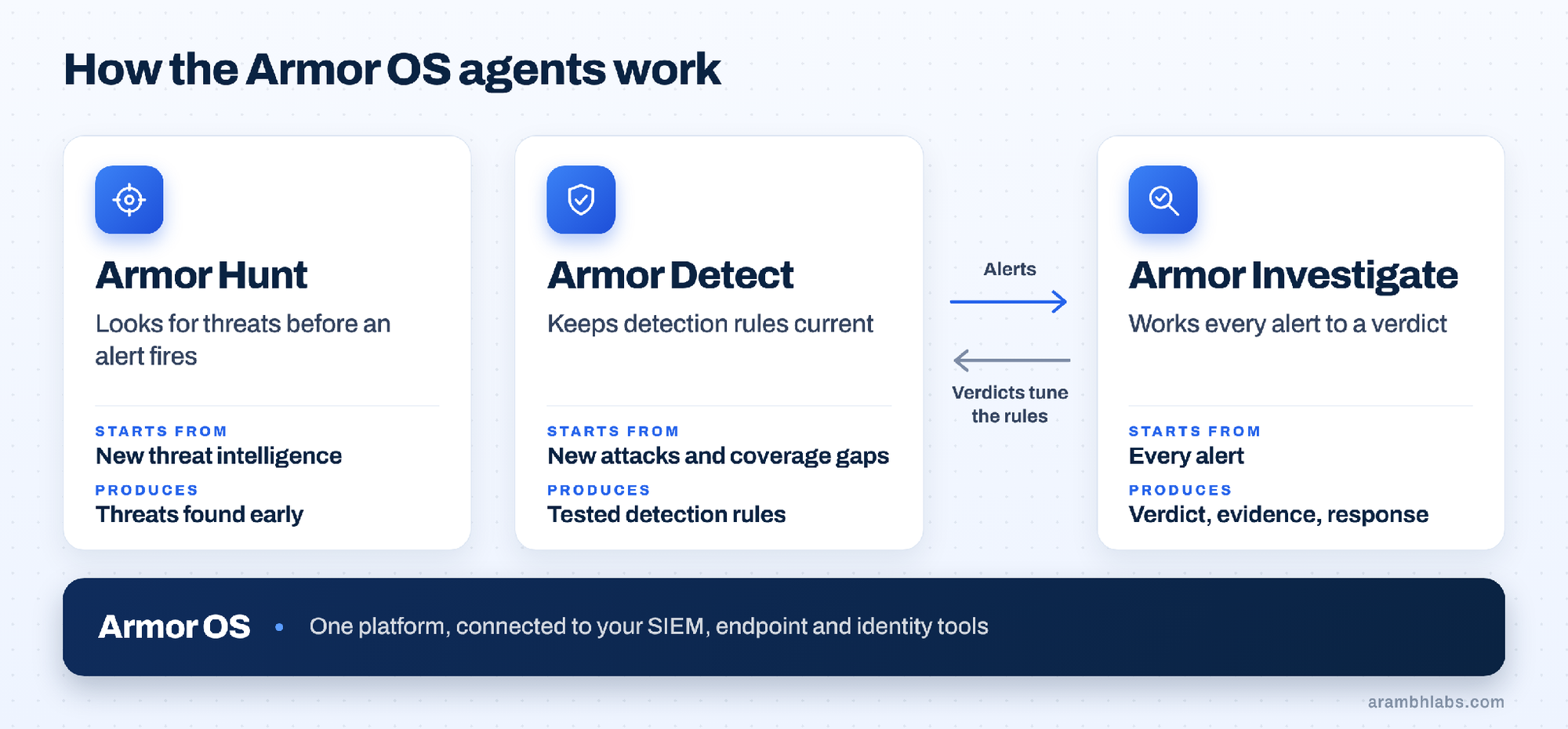
We built Armor OS because we believed every alert deserves a real investigation, and that no team has enough people to give it one. ARTEX has made that belief more urgent. In Armor OS, AI agents do the hunting, detection and investigation, and people make the decisions that matter.
Think about what an intrusion like this leaves behind. The agents explore a web application thoroughly before attacking it, which fills the logs with unusual requests. They try passwords across hundreds of accounts at a steady rhythm of about one a second. A stolen cloud key gets tested against dozens of permissions within seconds. A web server suddenly starts a command shell. Each of these lands in a different tool, usually as a low-severity alert.
Armor Investigate picks up every one of those alerts, including the ones a busy team would close in bulk. It builds a plan for each alert based on the customer's own environment, pulls the logs it needs from SIEM, endpoint and identity tools, and links the related signals into one sequence. Instead of four unrelated low-priority alerts, the analyst gets a single timeline of the attack with a verdict attached, in under five minutes. Our agents have investigated more than a million alerts in production, and only 5 to 10% of them end up needing an analyst.
Armor Detect keeps the rules current as the tool changes. ARTEX is already circulating as copies and forks, so a rule that matches its name or a known address goes stale quickly. A team can describe the behavior in plain English, such as failed sign-ins across many accounts spaced a second apart, and get a draft rule. That rule is replayed against the team's own historical data and against simulated attack logs before it goes live. Armor Detect also maps existing rules to MITRE ATT&CK techniques, so a team can see which steps of an intrusion it would catch today and which it would miss.
Armor Hunt answers the question every team asks after an advisory like the FBI's: has this already happened here? It starts from the published indicators and techniques, plans a hunt, and runs it across SIEM, endpoint and identity data. If the activity is there, it maps how far the intruder got and offers containment options.
When a threat is confirmed, Armor Investigate recommends the response and can carry it out, whether that means revoking sessions or isolating a host, with a person approving the actions that matter. Against an intrusion that reaches privileged access in under three hours, a verdict in under five minutes still leaves a team time to act.
Attackers now have agents that work every target at any hour without getting tired. We think defenders should have the same.