SOAR vs. AI Copilot vs. Agentic SOC: What's Actually Different

Sit through enough security vendor pitches and three terms start to blur together: SOAR, AI copilot and agentic SOC. Some vendors use all three for the same product. They describe very different things, though, and the easiest way to keep them apart is to ask the same question of each one. When an alert fires, who does the investigation?
The short answer is that SOAR leaves it to a script, a copilot leaves it to the analyst, and an agentic SOC hands it to software agents and has a person check the result.
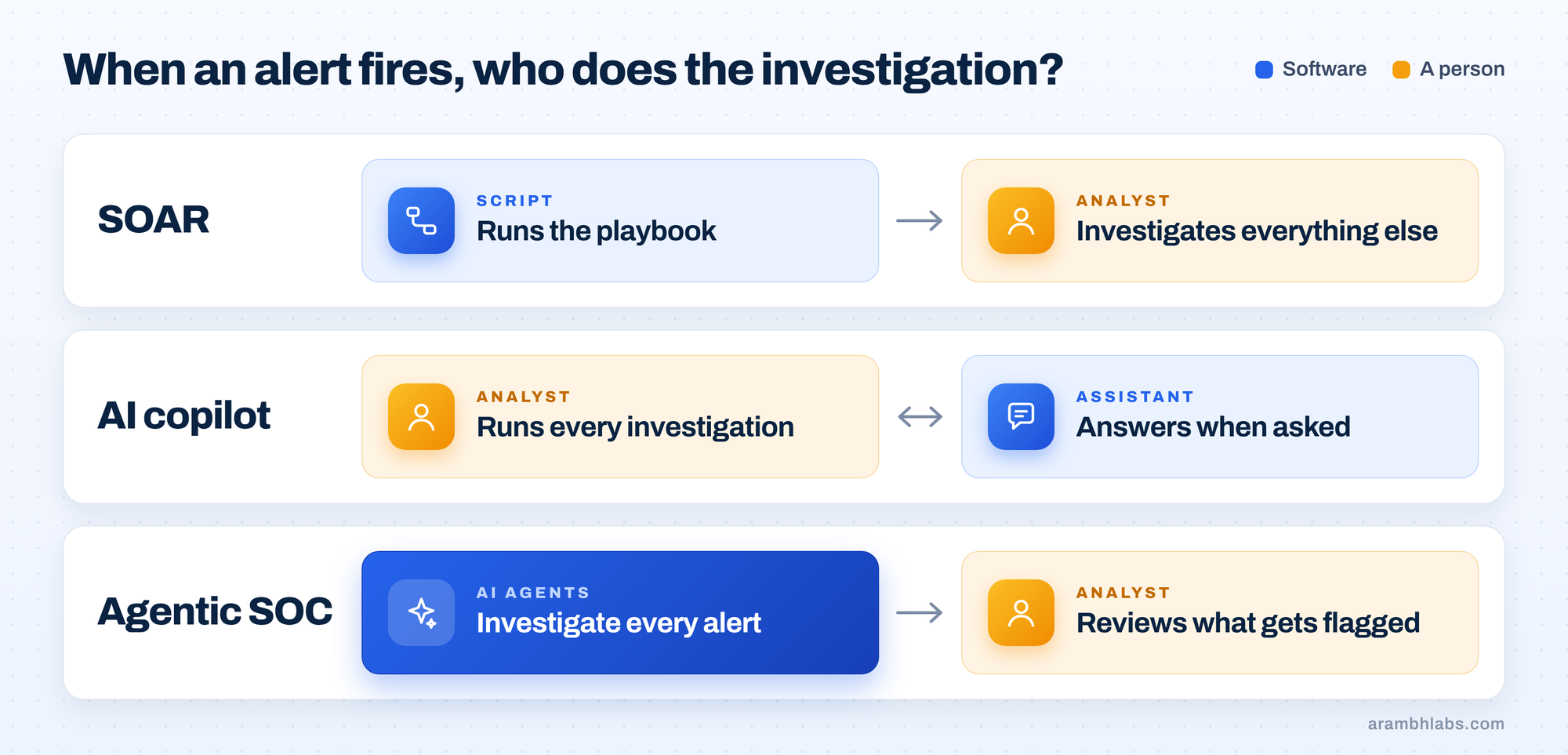
SOAR: automation that follows a script
SOAR is the oldest of the three. The name stands for security orchestration, automation and response, and it has been around since about 2017. Security teams were doing the same handful of tasks hundreds of times a day, so the idea was to write those tasks down as a workflow and let software run them.
Those workflows are called playbooks. A phishing playbook, for example, pulls the reported email, checks the sender against a blocklist, scans the attachment and opens a ticket, and nobody has to click through any of it. SOAR is still very good at that kind of work, and auditors like that it does the same thing every time.
The trouble starts with everything nobody wrote a playbook for. A new kind of alert goes straight to a person. So does a familiar alert in an unfamiliar environment. The playbooks that do exist also need looking after. Whenever a tool changes its API or the team adds a data source, somebody has to go back in and repair them, and plenty of companies ended up hiring an engineer just for that.
By 2024, Gartner had labeled SOAR "obsolete before plateau" on its Hype Cycle, as Dark Reading reported. Playbooks are still useful, but the category never became what people had hoped for, which was a way to automate the investigation itself and not only the chores around it.
AI copilots: an assistant that answers when asked
Copilots came out of the first wave of large language models. Microsoft announced Security Copilot in March 2023, and within months CrowdStrike, SentinelOne and Google had their own.
Using one is a bit like having a well-read colleague sitting inside the security console. An analyst types "summarize this incident" or "write the query to find every login from this IP address" and gets an answer in a few seconds. Anyone who has lost twenty minutes trying to remember query syntax will see the appeal. Junior analysts get the most out of it, because they can ask for knowledge that used to take years on the job to pick up.
What a copilot does not do is start anything. It waits for a question. Somebody still has to open the alert, decide what is worth looking into and make the call at the end. Each investigation gets shorter, but the number of investigations a person has to run stays exactly where it was. A team that could only get through part of its queue will get through more of it, and the rest will still sit there.
Agentic SOC: agents that do the investigation
The word "agent" gets used loosely, so it helps to be specific. An AI agent is software that is given a goal instead of a script. It works out which steps to take, takes them, looks at what came back and decides what to do next. In a SOC, the goal is usually to find out what an alert really is.
In practice it goes like this:
- An alert fires and an agent picks it up immediately. Nobody has to assign it.
- The agent plans an investigation for that type of alert in that particular environment.
- It carries out the plan by writing queries, pulling logs from the SIEM, endpoint, identity and cloud tools, and comparing what it finds.
- It comes back with a verdict (true positive, false positive or suspicious) and the evidence behind it.
Two things change as a result. One is coverage. There is no playbook to write, so a brand-new alert type gets investigated like any other, and so do the low-priority alerts a busy team would never have reached. The other is timing. The work starts when the alert fires, whether that is 3 PM on a Tuesday or 3 AM on a holiday.
The catch is that an agent is making judgment calls, and a verdict is only as good as the evidence behind it. An analyst has to be able to open any closed alert and see what was checked and what was found.
This is how we built Armor OS at Arambh Labs. At the managed security arm of a Big Four firm, Armor OS agents brought the average investigation down from 45 to 60 minutes to 5.3 minutes across more than 20 customer environments. About one alert in eight goes to an analyst, and it arrives with the investigation already done.
SOAR vs. AI copilot vs. agentic SOC, side by side
How to tell which one a vendor is selling
Almost every product in this market now calls itself an "AI SOC." SOAR vendors have added AI steps to their playbooks, and copilot vendors have started calling their features agents. The label on the slide says very little about what the product does once it is plugged in.
Plenty of teams also run more than one. SOAR is a perfectly good way to carry out a fixed response step, and a copilot is handy for one-off questions and threat hunting. What matters is knowing which one is working the alert queue.
The demo is a good first clue, because each type looks different on screen. A SOAR demo shows a canvas of boxes and arrows, which is the playbook. In a copilot demo, someone is typing questions. In an agentic demo, the screen shows a queue of alerts that have already been investigated, and nobody is typing anything.
After the demo, five checks during a trial will settle it.
Leave an alert alone. Pick one, do not touch it, and come back in an hour. If it looks exactly as you left it, the product is a copilot, whatever the name on the box. With agents, it should have a verdict by then.
Send it something it has never seen. A custom detection from your own environment works well, because no vendor could have prepared for it. If the response is "we would need to build a workflow for that," there is a SOAR engine underneath. An agent should plan an investigation anyway.
Open a closed alert. Look for the queries that ran, the data that came back and the reasoning that connects them to the verdict. A tidy paragraph saying "this activity appears benign" is only a summary, and it will not help when a customer or an auditor asks why the alert was closed.
Ask what had to be built first. How many playbooks, rules or prompts did the vendor's team set up before the trial started? How long did it take to get from connecting the data to the first investigated alert? A long setup usually means there is a lot of scripting behind the AI label.
Ask where the people are. Find out which actions the product takes by itself and which ones wait for approval. A vendor who has thought this through can answer in a sentence or two. If the answer is vague, treat that as a warning sign.
For a longer list of questions to bring to a vendor meeting, see How to Choose the Best AI SOC Platform in 2026.
Frequently asked questions
What is an agentic SOC?
An agentic SOC is a security operations center where AI agents investigate alerts autonomously. The agents plan each investigation, gather evidence from the organization's security tools and return a verdict. Human analysts review the cases that need a decision.
What is the difference between SOAR and an agentic SOC?
SOAR follows playbooks written in advance, so it only handles situations someone predicted. An agentic SOC uses AI agents that plan the investigation for each alert as it arrives, so new alert types and unfamiliar environments still get investigated.
What is the difference between an AI copilot and an AI SOC agent?
A copilot responds when an analyst asks it something, and the analyst still runs the investigation. An AI SOC agent starts the investigation itself when an alert fires and comes back with a verdict and the evidence behind it.
Does an agentic SOC replace SOC analysts?
No. Agents take over the repetitive investigation work, and analysts keep the decisions: reviewing ambiguous cases, responding to real threats and improving detections. The usual result is that a team covers its whole alert queue instead of a fraction of it.
Is "AI SOC" the same as "agentic SOC"?
Not always. "AI SOC" is a broad label that vendors apply to copilots, AI-assisted SOAR and agent-based platforms alike. "Agentic SOC" refers specifically to platforms where AI agents carry out investigations autonomously.
What is Armor OS?
Armor OS is the agentic SOC platform from Arambh Labs. It has AI agents for alert investigation, threat hunting and detection engineering that work across an organization's existing security tools, and every verdict comes with the evidence behind it.